Everybody loves a castle or a fort. We imagine knights on horseback, lowering the drawbridge & portcullis, a battering ram, catapult, perhaps even crocodiles in the moat.
The truth of course is that they were brutal places. Built to be impregnable, usually somewhere high up, they could reign terror on any attackers – arrows, boiling oil & water, rocks, all cascading down.
Here are some of the favourites I have visited down the years.
Krak des Chevaliers, Syria
Perhaps the ultimate crusader castle. I visited in 2009. The views were amazing, you could see for many miles across Syria and towards the Lebanese border.
The site was first inhabited in the 11th century by Kurdish troops garrisoned there. In 1142 it was given over to the order of the Knights Hospitaller. It remained occupied by them until it was reconquered by the Muslims in 1271.


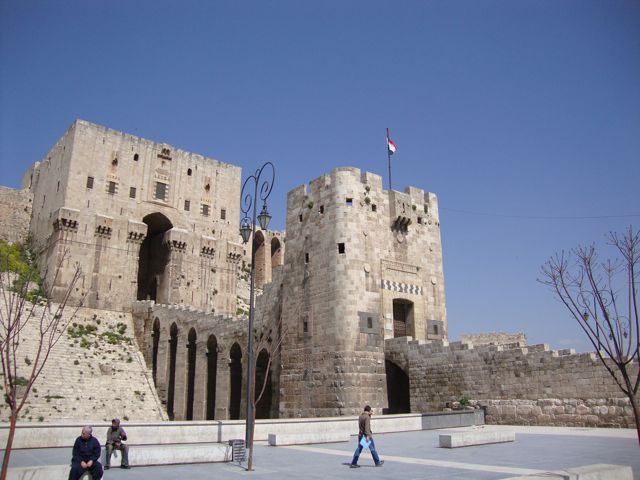
Aleppo Citadel, Syria
Staying in Syria and the huge castle in the middle of the second city.
Usage of the Citadel hill dates back at least to the middle of the 3rd millennium BC.
Occupied by many civilizations over time – including Arameans, Assyrians, Greeks, Arabs, Armenians, Romans, Byzantines, Ayyubids, Mamluks and Ottomans – the majority of the construction as it stands today is thought to originate from the Ayyubid period
The entrance to the citadel is via a path with a series of switchbacks, designed to make it extremely difficult to invade on horseback.




Palmyra Fort, Syria
Palmyra is best known for its Roman ruins, sadly damaged by ISIS, but there is also a hillside fort overlooking the ancient Roman city.

Salad-din’s Castle, Syria
Saladin (Salah ad-Din 1137-1193) is an Islamic hero, credited with defeating the Christian crusaders and expelling them from the country. The castle that bore his name was also great – vast, in good condition and with fabulous views for miles around.
He was the first sultan of Egypt & Syria and the founder of the Ayyubid dynasty. A Sunni Muslim of Kurdish ethnicity, he led the Muslim military campaign against the Crusader states in the Levant.
At the height of his power, his sultanate included Egypt, Syria, Upper Mesopotamia (Iraq), the Hejaz (Saudi Arabia), Yemen and other parts of North Africa.

We stopped as we approached by taxi from above to get a bird’s eye view and chatted to a father and his young family who sat on a bench just passing the time away.
The four girls were aged about seven downwards and I will never forget their beautiful smiles as they eagerly posed for a photo, whilst their proud father beamed. They should hopefully be in their twenties by now………..

Our taxi driver pulled into the castle environs, steering us past a giant stalactite like boulder that seemed to have sprung from the ground.
Theories abound as to how it got there, my favourite being that it was God’s staff, planted in displeasure at the deeds of man.

We entered the castle by a huge gate reminiscent of the other castles we had already visited. As we approached we noticed a camel that was being touted for rides around the perimeter. We did not partake, but I will always remember that camel as it has become my blog & Twitter avatars!

The castle looked pretty impregnable with its mighty thick walls and elevated position. Castles were fast becoming my new favourite places, a male thing I am sure.
A group of bored looking guides sat in the keep and they all shot up as we arrived, eager to make a welcome buck as tourist numbers were low. Sadly for them, Hamish & I are both devout guide shunners, preferring to just wander, imagine and read the 2-3 paragraphs in our Lonely Planet.


Desert Castles, Syria
Finally in Syria, we tool a taxi north from Aleppo to two castles in the region that was to become an ISIS stronghold.
Qal’at Najm is positioned high up on the right bank overlooking the Euphrates River. The vegetation here was noticeably lusher due to the proximity to the water and consequently the sparse livestock somewhat fatter than we had seen before.

Like the Citadel of Aleppo, the entrance was characterized by a ramp and a massive gate with four bends, designed to make it difficult for an invading force to charge up into the battlements.
The castle was well preserved and great for scrambling around, but it was the location that was the real winner.


Nearly three hours and 150 km later we arrived at our second castle, Qal’at Ja’bar. We were now a lot closer to Raqqa than Aleppo, on the banks of Lake Assad.
The castle was reached by boat skippered by a really cool dude, a great way to arrive.

The setting was more memorable than the castle itself, not that we did not have fun once more clambering around.


Desert Castles, Uzbekistan & Turkmenistan
In 2018 I visited two amazing Stans, the former stuffed with mesmerising Islamic architecture, the latter with amazing yet bizarre architecture, especially in capital Ashgabat.


Something both stunning countries have in common are desert castles, near Ashgabat and Ancient Merv in Turkmenistan & north of Khiva in Uzbekistan.


Sidon, Tyre & Byblos in Lebanon
I visited in 2000, travelling the length and breadth of the small Mediterranean country.
All three castles are on the coast for defence against marauding fleets.


Ajloun Castle, Jordan
Ajloun Castle is high above the Jordan Valley. The fortress was built by Izz al-Din Usama, a commander and nephew of Salah ad-Din al-Ayyubi (Saladin), in AD 1184-1185.


Osaka, Japan
Ancient samurai castles were once commonplace in Japan. Built of wood however many have been destroyed over the years.
The one in Osaka has been faithfully restored.


Hiroshima, Japan
Best known for the tragic nuclear attack at the end of WWII, Hiroshima also has a fine restored castle complex.


Hue Citadel, Vietnam
Ancient Hue was visited in 1998 as the start point of my Reunification Express journey to Hanoi.
The Hue Historic Citadel, or Dai Noi Hue, stands as one of Vietnam’s most iconic and well-preserved historical landmarks.
Located in the heart of Hue City, the Citadel is not only a UNESCO World Heritage Site but also a powerful testament to the grandeur of Vietnam’s feudal past.


Coming next – Roman sites of Middle East & North Africa

